
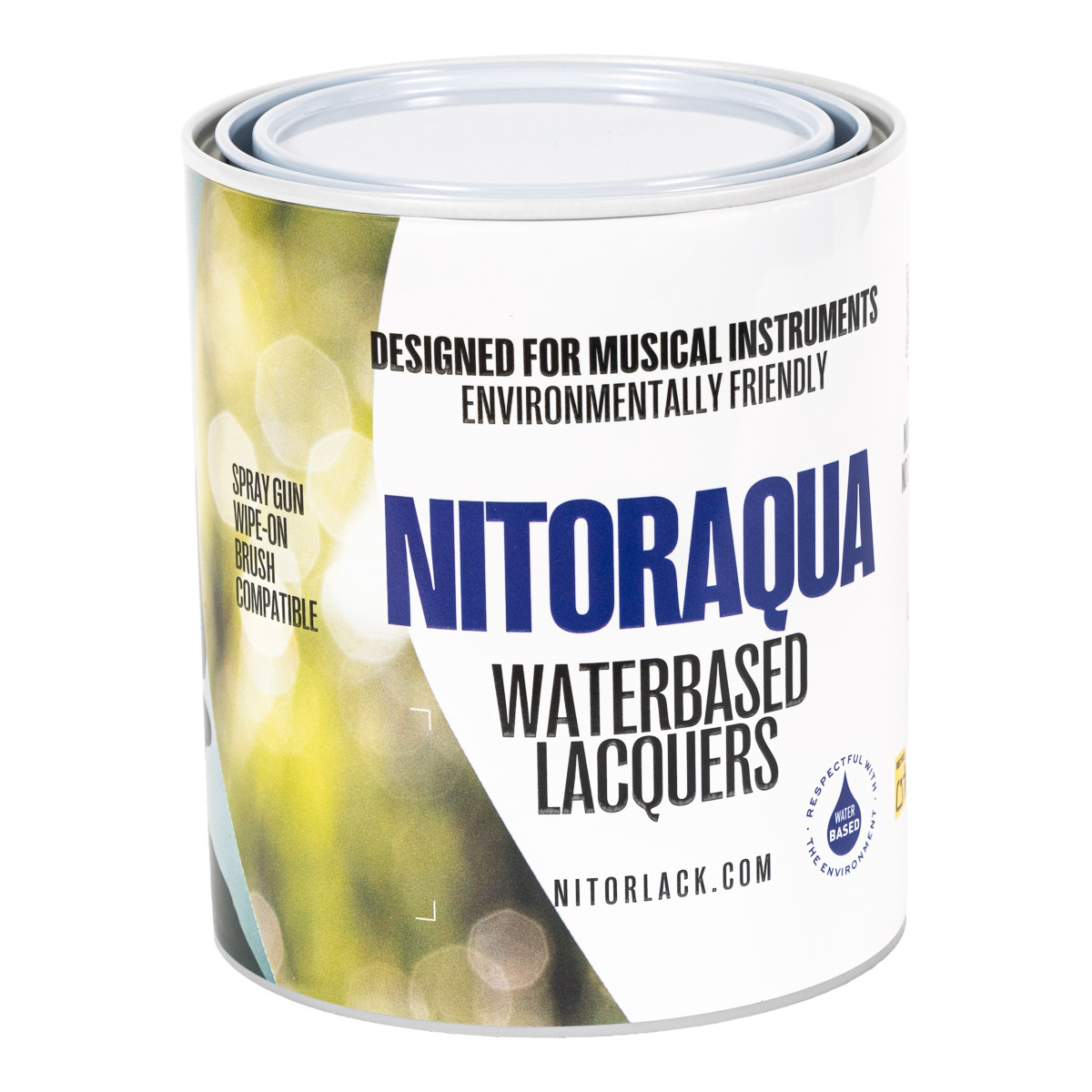
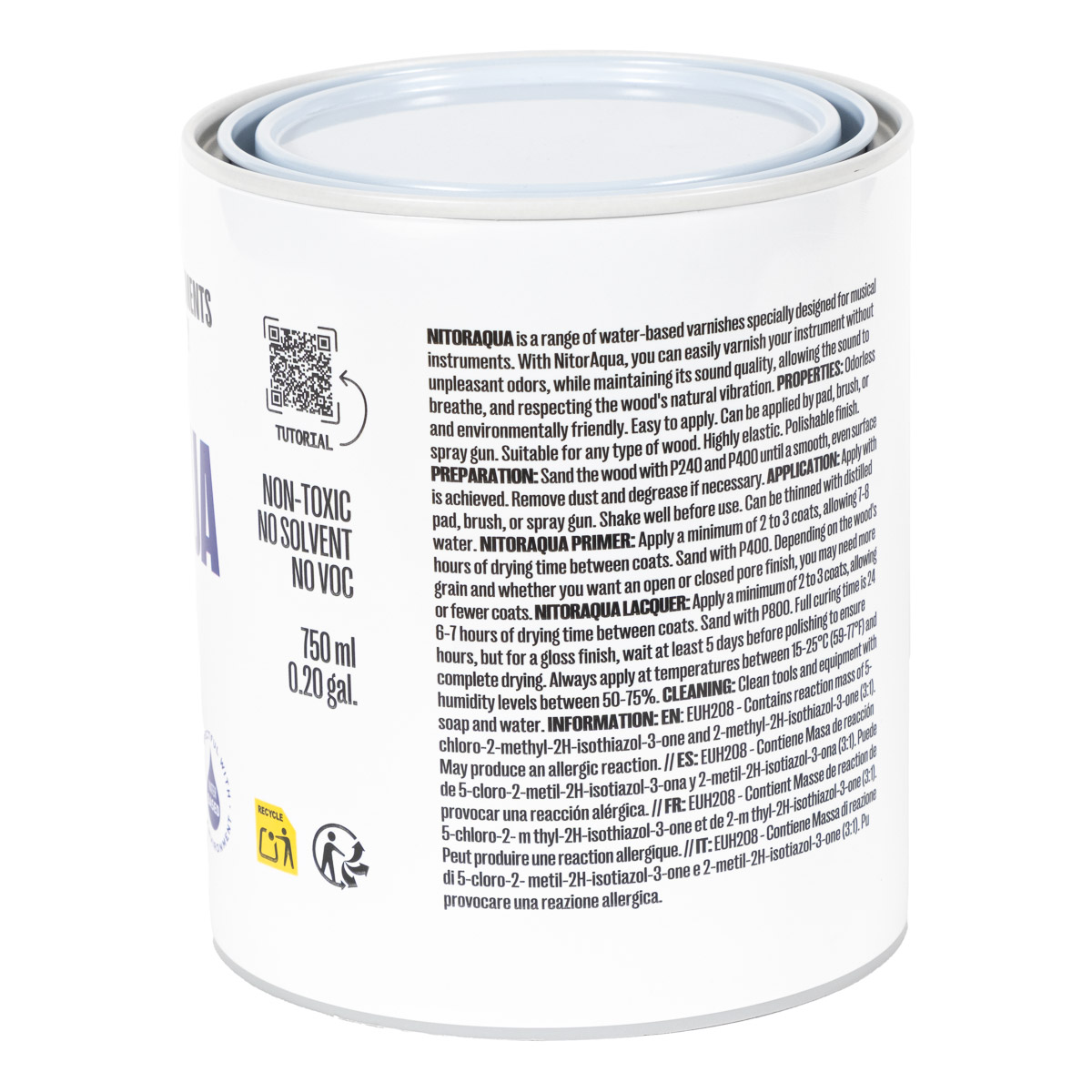
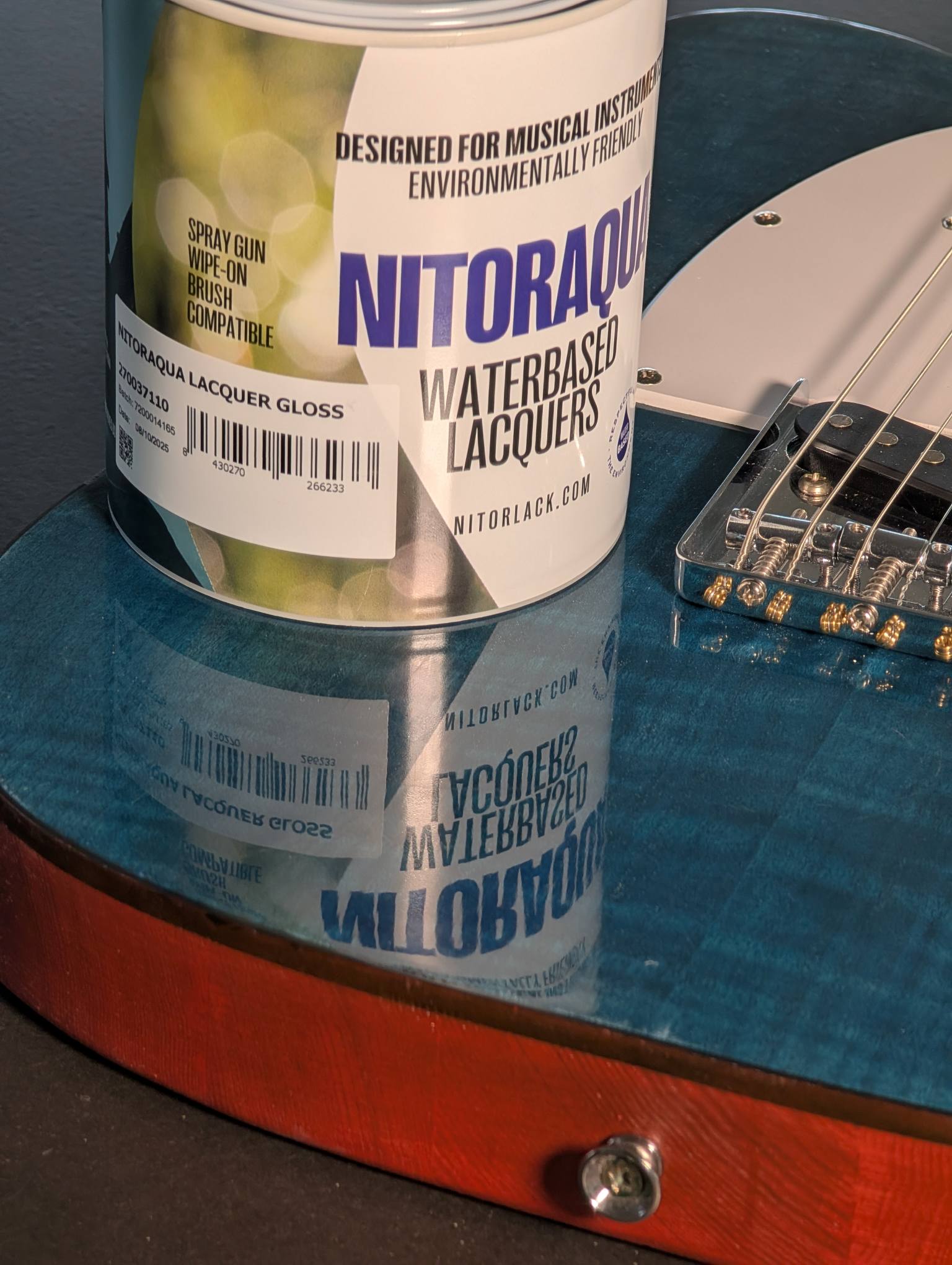


NitorAqua Lacquer is a water-based lacquer designed for finishing guitars and other wooden instruments.
Its formula allows for comfortable working thanks to its easy application with a foam brush, although it can also be applied with a spray gun, creating a transparent film that can be sanded and polished.
It is an ideal solution for those seeking a high-quality finish, with a cleaner, low-odor process that is simpler than traditional solvent-based systems.
NitorAqua Lacquer allows you to build up progressive layers of varnish, level the surface through sanding, and achieve a smooth, uniform final finish with a high gloss level.
It can also be used for matte finishes. In that case, the final polishing step is not necessary.
What is NitorAqua Lacquer used for?
NitorAqua Lacquer is used as a water-based finishing lacquer to protect guitar wood and enhance its final appearance.
Its main function is to create a transparent layer over the surface, protecting the stain or natural wood and helping achieve a smooth, even, professional finish.
It can be applied over:
✅ Properly sanded natural wood.
✅ Previously stained wood.
✅ Surfaces prepared with NitorAqua Primer.
✅ Nitrocellulose or polyurethane bases, including the full color range.
Main advantages
✅ Easy-to-apply water-based lacquer.
✅ Low odor compared to traditional solvent-based systems.
✅ Suitable for manual application with a foam brush.
✅ Suitable for spray gun application.
✅ Compatible with NitorAqua staining processes.
✅ Allows gloss finishes.
✅ Can be used in matte finishing processes.
✅ Allows progressive layer building until a smooth, even surface is achieved.
✅ Easier cleaning than traditional solvent-based systems.
Wood preparation
Good wood preparation is essential to achieve a clean, even, and durable finish.
Before applying NitorAqua Lacquer, the surface must be properly sanded, clean, dry, and free of dust, grease, previous product residues, or irregularities.
1. Initial sanding
Sand the guitar with P240 sandpaper until the surface is smooth and even.
It is important to always work in the direction of the wood grain and avoid deep sanding marks.
2. Raising the grain
Lightly dampen the wood surface with water and let it dry.
This step allows the grain to rise, meaning the small wood fibers or “hairs” that may lift when applying water-based products.
3. Fine sanding
Once the surface is dry, sand with P400 to remove the raised grain and prepare the wood to receive the stain or lacquer.
Application over stained wood
NitorAqua Lacquer can be applied over previously stained wood.
To obtain an even result, it is important that the stain is well distributed and completely dry before starting the lacquering process.
If you want to better protect the color before applying the following lacquer coats, it is recommended to mix the second coat of stain with approximately 15% NitorAqua Lacquer.
This mixture helps fix the stain and reduces the risk of dragging the color during later coats.
Manual application with a foam brush
Manual application is a practical option for finishing work without the need for spray equipment.
For this method, it is recommended to use a foam brush, which allows the lacquer to be spread smoothly and with control.
Recommended dilution for manual application
1 part NitorAqua Lacquer + 1 part water
This equals an approximate dilution of 50%.
Mix well until the product is completely blended.
How to apply it
Apply the lacquer with the foam brush following the direction of the wood grain.
Spread thin, even coats, avoiding excessive product build-up.
Once the entire surface is covered, allow it to dry for 4 to 6 hours before sanding or applying a new coat.
Sanding between coats
When the coat is dry, sand gently with P800 to level the surface and remove small imperfections.
Then remove all sanding dust thoroughly before applying the next coat.
Repeat the application and sanding process until the surface is completely smooth, even, and free from visible irregularities.
Spray gun application
Spray gun application allows for more even coats and is especially recommended when looking for a professional finish or when working on large surfaces.
The general process is similar to manual application, although the dilution, application method, and drying times are different.
Recommended dilution for spray gun
To apply NitorAqua Lacquer with a spray gun, the following ratio is recommended:
70% NitorAqua Lacquer + 30% water or distilled water
Mix well before pouring the product into the spray gun.
How to apply it with a spray gun
Apply thin, even coats, avoiding overloading the surface.
Keep a constant distance between the spray gun and the guitar, making regular overlapping passes to achieve an even distribution of the product.
It is better to apply several thin coats than one excessively heavy coat.
Once the entire guitar is covered, allow it to dry for at least 12 hours before sanding or applying a new coat.
The drying time is longer than with manual application because a spray gun usually applies a higher proportion of lacquer in each coat.
Using NitorAqua Primer or sanding sealer
For spray gun applications, it is recommended to use a sanding sealer or primer in the first coats.
Usually, 2 or 3 coats of NitorAqua Primer are applied before starting the final finish.
What is the primer used for?
The primer helps to:
✅ Seal the wood pores.
✅ Even out surface absorption.
✅ Make sanding easier.
✅ Reduce the time needed to achieve a smooth surface.
✅ Better prepare the wood for the final coats of NitorAqua Lacquer.
Can the primer be omitted?
Yes, it can be omitted.
NitorAqua Lacquer can cover the pores and level the surface by itself. However, using a primer is recommended, especially for spray gun application, because it speeds up the process and makes sanding easier.
The primer has greater filling capacity and is easier to sand, making it especially suitable for the first stages of the finish.
Final sanding
Once the final coat of lacquer has been applied and the finish is completely dry, carry out progressive sanding in stages.
Recommended sequence
- P1000
- P1500
- P2000
- P3000
Sanding can be done dry or wet.
The goal is to leave the surface completely smooth, soft, and ready for polishing.
The surface will be ready for polishing when it is completely matte, with no isolated shiny spots, marks, orange peel, or visible irregularities.
Polishing the finish
The polishing process should only be carried out on gloss finishes.
If a matte lacquer has been chosen, this step should be skipped so as not to alter the final appearance.
Cutting polish
Use our Nitorlack Compound Cut polish + white polishing sponge.
Shake the polish bottle vigorously until the product has a creamy appearance.
Apply a thin layer to the surface and start polishing with a white cutting or abrasive sponge.
Work in a controlled way, without applying too much pressure and avoiding overheating the surface.
Finishing polish
Clean off the excess polish with a clean cloth before moving on to the next stage.
Use Superfinish polish with the black sponge to achieve the highest possible gloss level.
This second step helps refine the finish and increase the depth of the gloss.
Final cleaning
After polishing, it is normal for the guitar not to show its full final gloss yet, as polish residue may remain on the surface.
To remove it, use a clean cloth and a little Polish & Cleaner.
Lightly dampen the surface, clean off the residue, and wipe again until the finish is clean and shiny.
Once this step is complete, the gloss level should be high and the surface should have a clean, even, professional appearance.
Usage recommendations
To achieve the best result with NitorAqua Lacquer, we recommend following these guidelines:✅ Do not try to achieve the final finish in a single coat.
✅ Respect the drying times between applications.
✅ Completely remove sanding dust before applying a new coat.
✅ Avoid applying the product on wet, dirty surfaces or surfaces with grease residue.
✅ Do not apply excessively thick coats, as they may extend drying time and make sanding more difficult.
✅ Use clean water or distilled water for dilution, especially for spray gun application.
✅ Work in a clean, dust-free, well-ventilated space.
✅ Before working on the final guitar, test the product on a similar piece of wood.
Common mistakes to avoid
Not raising the grain before finishing
When working with water-based products, the wood fibers may rise.
That is why it is important to dampen the wood first, let it dry, and sand with P400.
Not mixing the product properly
Before using NitorAqua Lacquer or any compatible stain, the product should be shaken or mixed properly to ensure even application.
Polishing too soon
If the lacquer is not completely dry or hardened, polishing may mark the surface or cause defects.
It is advisable to check that the finish is firm before starting.
Not cleaning properly between stages
Sanding dust or polish residue can affect the final result.
Each stage should be carried out on a clean surface.
Frequently asked questions about NitorAqua Lacquer
Can it be applied by hand?
Yes. It can be applied manually with a foam brush.
For this method, it is recommended to dilute the product by 50%, mixing one part NitorAqua Lacquer with one part water.
Can it be applied with a spray gun?
Yes. It can also be applied with a spray gun.
In this case, an approximate dilution of 70% lacquer and 30% water or distilled water is recommended.
Can I apply NitorAqua Lacquer directly over the stain?
Yes. It can be applied over stained wood, as long as the stain is dry and evenly distributed.
To better protect the color, it is recommended to mix the second coat of stain with 15% NitorAqua Lacquer.
How long should I wait between coats?
For manual application, the recommended drying time is between 4 and 6 hours.
For spray gun application, it is recommended to let it dry for at least 12 hours before sanding or applying a new coat.
Do I need to sand between coats?
Yes. It is recommended to sand gently between coats with P800 to level the surface and remove small imperfections.
Which sandpapers are used before polishing?
For final sanding, a progressive sequence is recommended:
P1000 → P1500 → P2000 → P3000
The goal is to leave the surface completely smooth and matte before polishing.
Can I do the final sanding wet?
Yes. Final sanding can be done dry or wet, always carefully and making sure the surface remains even.
Can a glossy finish be achieved?
Yes. If a gloss finish version is used and the final sanding and polishing are carried out correctly, a high gloss level can be achieved.
Is polishing always necessary?
No. If a matte lacquer is used, the polishing process should not be carried out, as it could alter the final finish.
What happens if shiny spots remain during final sanding?
It means that the surface is not yet completely leveled.
Before polishing, the entire surface should be uniformly matte, with no shiny areas or visible irregularities.
Can I apply more coats if I want more protection?
Yes. The finish is built through successive coats.
It is important to apply thin coats, respect drying times, and sand between them when necessary.
Can I use it on open-pore woods?
Yes, but on porous woods it is recommended to use a primer or sanding sealer to help seal the pores and obtain a smoother surface.
If you want a finish that shows the pores, apply 2 or 3 coats of NitorAqua Lacquer directly, either matte or gloss.
What should I use to clean off excess polish?
After polishing, the surface can be cleaned with a clean cloth and Polish & Cleaner to remove product residue and reveal the final gloss.


Jose (verified owner) –
Barniz muy bien hecho, aún siendo al agua deja muy buen brillo. Facil de aplicar y también de pulir.
Aunque sea más caro que otros barnices del mercado merece la pena ya que se termina ahorrando tiempo y trabajo.
Merece la pena. Volveré a comprar.
Nitorlack (store manager) –
gracias por tu comentario, es de gran ayuda para nosotros.
Dario Larosa (verified owner) –
M M. (verified owner) –
Easy to apply and dilute with acrylic thinner. Flows well and dries fast. It is more difficult to avoid a blue haze, especially on black.
Anónimo (verified owner) –
No lo he usado todavía, espero que funcione bien.
Frédéric Carayon (verified owner) –
HASEBROUCK Joanes (verified owner) –
Vraiment un très bon produit.
Jose T. (verified owner) –
Aún siendo un barniz al agua tiene mucho brillo, se pule bien y queda bastante resistente.
Xavier M. (verified owner) –
Perfecto.
Spreutels V. (verified owner) –
The perfect varnish, I work with it since 2 years. The sound is great and the visuel is really good
JUAN JOSE CID COTOBAL (verified owner) –
Pierre Guitarservice ApS – Dubre (verified owner) –
Excelent..! best product ever.. 🙂
DURAN (verified owner) –
Rodrigo (verified owner) –
Creo que este producto merece una buena valoración. Para mi gusto es el mejor acabado que podemos darle a un instrumento sin que pierda propiedades sonoras, puedo decir que lo he puesto a prueba en guitarras durante 3 años incluso en condiciones desfavorables de sol, lluvia, calor, roces, golpes, etc y responde fenomenal.
No tiene la dureza del poliuretano pero tampoco el grosor y eso para mí es una ventaja.
– Apenas desprende olores
– Se le puede sacar el mismo brillo que al poliuretano
– No se seca dentro del recipiente
– Admite muy bien los tintes incluso mezclando varios colores
– Es muy elástico y no he notado que se quiebre
– Se puede reparar
Cuando está acabado deja una sensación de transpiración que no la encuentro en otros acabados, merece la pena probarlo tanto el brillo como el mate.
Con dos manos de fondo y 3 de acabado bien nivelado se pude dar por finalizado, con 7/8 capas de acabado tienes poco grosor y un brillo espectacular.
Rémi Langlumé (verified owner) –
Excellente qualité – Simple d’utilisation avec un pistolet buse 1,4 sans dilution – 5 couches séparées de 24h avec ponçage 500 puis 1000 puis 1200…
Anónimo (verified owner) –
Muy buen producto. Se aplica y trabaja bien, apenas desprende olores y seca muy rápido. Ampliaría el tutorial de aplicación con mas detalles, videos y trucos para arreglar errores como descuelgues, o marcas de polvo… para novatos como yo eso seria de mucha ayuda…
Peter (verified owner) –
Good product, well packed, reasonable delivery time. Recommended
Anónimo (verified owner) –
Buen barniz. La única pega los gastos de envío.
Rémi Langlumé (verified owner) –
Facile a utiliser – 10 couches au pistolet buse 1.4 poncage 350 entre les couches puis 500 jusqu’à 5000 puis lustrage sur la dernière couche après 3 semaines de séchage – Nettoyage des outils aisé. A voir sur la durée pour le moment c’est top.
Jean-luc M. (verified owner) –
Good product, easy to use. I find it a little bit thin so you need to ensure the wood is properly filled before application. Not sure what kind of laquer it is, no mention on the box or on the website.
Ester R. (verified owner) –
Nos llegó el paquete en mal estado. Tres días antes de ir se de vacaciones en la tienda. Al día siguiente teníamos el producto en casa perfecto. Llevamos años comprando y seguiremos. Muchas gracias.
jean jacques (verified owner) –
Giedrius K. (verified owner) –
Awesome lacquer. Easy to handle easy to sand layers and made it smooth. Recommend! 🙂
Christoph Schulze (verified owner) –
Eliseo X. Zaera (verified owner) –
Genial!!
Peter Sebo (verified owner) –
I use the clear gloss version for finishing acoustic guitars. I use DeVilbiss DV1s mini gun with 1.2mm nozzle. Small Gentilin compressor and below 2bar pressure under the gun. Works great.
Jérôme VitellaJérome (verified owner) –
Javier Alonso Jimenez (verified owner) –
Vincenzo Amari (verified owner) –
Ottima finitura trasparente
Vincenzo Amari (verified owner) –
Usato per rifinire un kit Harley Benton con ottimi risultati.
Arne Kühr (verified owner) –
Kent Bergkvist (verified owner) –
Everything perfect
Kent Bergkvist (verified owner) –
jean louis lafont (verified owner) –
Ce produit est une nouvelle formule. Je suis encore en cours dévaluation. Sa viscosité est importante (200 a 250 din 4).
J’ai eu recours au support valresa pour avoir la fiche technique du produit. Le support m’a répondu immédiatement, c’est très pro.
La préconisation d’utilisation du produit pour une pulvérisation au pistolet est une dilution entre 5 et 10% et l’utilisation d’une buse de 1.4. Bien sur dans des conditions de température (>15°) et d’humidité (>75%) normales.
Je vais tester la semaine prochaine mais ça me semble cohérent.
Geoffrey Cattani (verified owner) –
Sylvain H. (verified owner) –
Facile à utiliser, pas d’odeur, se lisse facilement, pas de coulures. Top.
Nicolas (verified owner) –
Verni très facile à appliquer dilué, devient très dur en séchant avec un bel aspect et une consommation très réduite. Sans odeur c’est une vraie solution efficace à comparer des aérosols. Je recommande largement
Andrea Palmioli (verified owner) –
Thierry M. (verified owner) –
Miguel (verified owner) –
Buen producto, acabado muy bueno. La pena que no vendan acabado Satinado.
Jean-Sébastien (verified owner) –
Très bon vernis, facile à poser, s’est très bien marié avec le vernis existant sur ma guitare depuis 1991.
Michel PRUDON (verified owner) –
Easy to apply, for a great result
Domenico Costa (verified owner) –
Thierry (verified owner) –
L’application est facile et le rendu bluffant si on respecte bien tout le processus.
ludovic.boutee (verified owner) –
Très bon produit ! L’application est super facile à l’éponge, bien plus facile et moins contraignant qu’en bombe ou pistolet (pas d’odeur, pas de salissure, pas de risque de coulure…) ! Le résultat est également très bon : bon pouvoir de remplissage, très bon lissage et séchage rapide permettant de faire de nombreuses couches. pour mon usage, même pas besoin de poncer/polir à la fin pour avoir un bon résultat !
La consommation pour une guitare est très faible également. Je pense pouvoir faire 10 guitares avec un pot facilement.
Il y a toujours le problème de dureté, propre à l’acrylique : le vernis marque facilement par rapport à un PU. Attention à bien protéger la guitare lors de l’assemblage notamment.
Thierry Lolmede (verified owner) –
Super produit
Jean Charles Vigneron (verified owner) –
David Wicks (verified owner) –
Definitely recommend
arcangelo pignatelli (verified owner) –
Prodotti ottimi, spedizione troppo costosa. Great product, shipping costs are excessive
Gregory H. (verified owner) –
Une révolution !! J’adore. C’est facile à poser et le rendu est parfait
Yannick MABO (verified owner) –
Très bien. Utilisé avec le pinceau mousse. Le vernis tire très bien suivant la dilution à l’eau distillée. Facile à teinter également.
Manuel (verified owner) –
Douglas M. (verified owner) –
Excelente, sirve de fondo y acabado e incluso me gusta mas que el primer ya que tiene mas cuerpo, aplicación facil y acabado insuperable es duro y resistente, tenía mis dudas , pero es realmente un extraordinario producto
Stéphane R. (verified owner) –
Iñaki Hernando (verified owner) –
Roberto (verified owner) –
Laurent B. (verified owner) –
Anakin (verified owner) –
Use the sponge!
MARCO L. (verified owner) –
El producto es impecable. Fácil de aplicar y con un acabado espectacular.
georges PERRETON (verified owner) –
Parfait , j’ai commandé pour tests du vernis nitoraqua et les pâtes à polir… résultats excellentissimes pour un vernis phase aqueuse
Stéphane M. (verified owner) –
Très bonne qualité. Sèchage rapide. Très bon résultat
PAUL LAOUE (verified owner) –
Omar Ghisetti (verified owner) –
Massimo (verified owner) –
Philippe G. (verified owner) –
Parfait ! Merci